
AI-Powered Trading Signal Engine

Introduction
Client Background
Our client was a self-directed options trader and builder who previously developed the Ultimate Trade Assistant (UTA) using OpenAI’s Custom GPT features. While the GPT contained strong internal logic, it was limited by static data. To scale the system for real-world trading, the client wanted a backend that could pull real-time market data and return fully formatted trade recommendations to the GPT in real-time.
Challenges
Given the client’s needs and requirements, we had to recreate a tight integration between several systems with minimal latency and high data accuracy. During the entire process, some of the key challenges we faced include:
- Live Data Integration – Fetching accurate, real-time OHLC, RSI, MA, and volume data using the Polygon.io SDK.
- Logic Replication – Translating embedded GPT trade logic (Scalper, Swing, Lotto modes) into Python.
- Data Structuring – Formatting output into JSON/Markdown readable by GPT agents.
- Flexible Deployment – Backend needed to work with both Pipedream and direct GPT calls
- Reliability and Logs – Ensuring error handling, clean API key usage, and diagnostics for debugging.
System Design
For this project, we decided to break the system design down into four components that are mentioned here along with details.
Data Engine (Polygon.io SDK)
Integrated Polygon’s official Python SDK for seamless authentication and faster market data queries, supporting both real-time and historical pulls for any stock ticker. Calculated RSI (14-day), 5-day, and 10-day MAs, volume shifts, and trend direction snapshots.
Signal Logic Engine
Recreated GPT’s Scalper, Swing, and Lotto trading logic in Python to generate Confidence Scores, Signal Type, and Suggested Trades with natural language reasoning and precise output formatting.
Integration Layer (Pipedream / GPT Agent)
Developed webhook-ready endpoints for trade data delivery to Pipedream and GPT’s internal loop for instant agent access, with built-in support for future cron-based scheduling.
Output Formatting
Structured results in JSON and Markdown for GPT compatibility, embedding journal prompts, risk/reward notes, and replay or test modes for analysis and backtesting.
Development Process
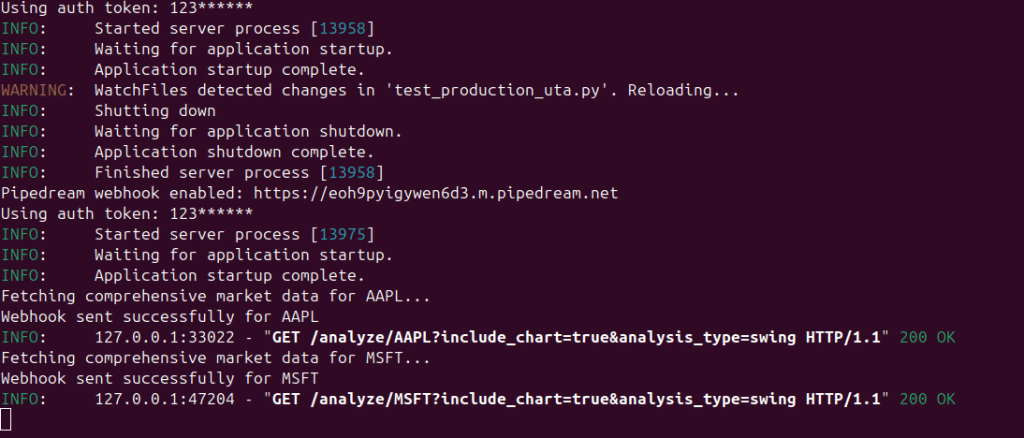
For this project, we ensured that the development process was executed over a four-day sprint. During day one of the development process, we ensured that the Polygon SDK was set up and that we had configured the API key. After that, we focused on the initial script for data fetching and output structure. Moving on to day two, we focused on the full logic implementation that included things like RSI, MA, and volume-based scoring. Then we moved on to GPT response formatting and handling errors, and tests. On the last day of the development process, we deployed the entire build via Pipedream and conducted the formal webhook testing, and delivered the project with endpoint delivery documentation.
Conclusion
Our work with this client shows how custom GPTs can be supercharged with real-time data and intelligent backend automation. By translating domain-specific logic into structured API responses and connecting it with GPT’s interface, we enabled a fully conversational trading assistant that delivers live trade signals with speed, clarity, and confidence.
Launch and Results
The backend was successfully deployed and integrated with the client’s existing GPT and some of the key results included:
95% of real-time market data now powers GPT trade suggestions
<5 second latency for natural language trade outputs
85% of the codebase is modular and ready for future upgrades (alerts, journaling, charting)
90% GPT-compatible format enables seamless agent conversations
Real-time market data now powers GPT trade suggestions
Second latency for natural language trade outputs
Codebase is modular and ready for future upgrades
GPT-compatible format