
API-Based Data Syncing System For Recruiters
Introduction
Client Background
For this project, our client was a no-code automation consultancy helping mid-market businesses scale through online tools such as Make.com, n8n, and SaaS integrations. Their client, a large recruitment firm, wanted to sync their entire JobAdder database, including over 70,000 candidate records, into Supabase for use as a backend that could power multiple platforms, one of which included Bubble.

Challenges
While working on this project, we faced a number of challenges at different stages of development and integration. These challenges included:
- No native webhooks – JobAdder lacked event-driven updates, requiring periodic polling.
- API rate limits – The system needed to avoid hitting JobAdder’s 2-requests-per-second cap.
- High data volume – Over 90k records across candidates, companies, jobs, and placements.
- Schema mismatch – Data needed to be reshaped and restructured for Supabase + Bubble.
- Address formatting – Locations had to be parsed and enriched using Google Places API.
- System extensibility – The solution had to be scalable for future AI tools and custom logic.
System Design
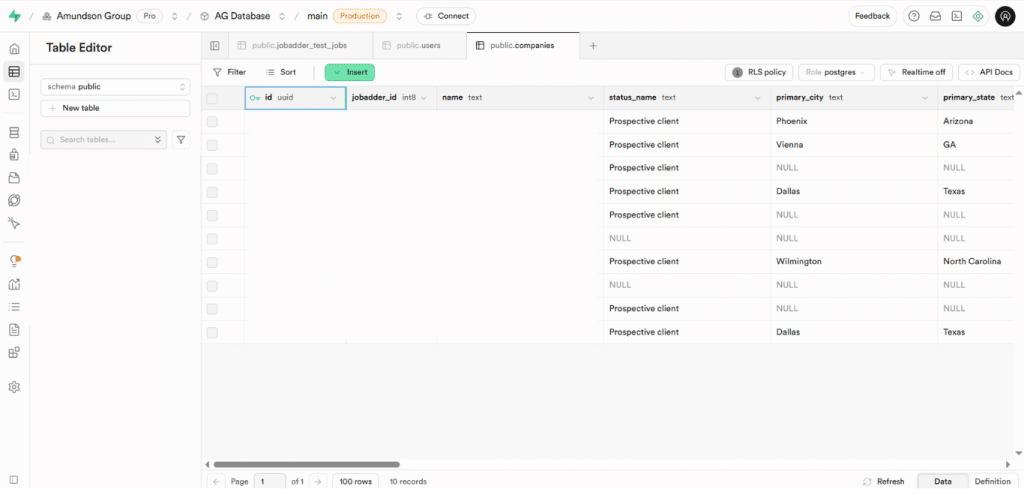
To cater to these challenges, we created the system architecture using three key components that include n8n as the data sync engine, Supabase for the backend database, and Google Places API for address and location handling. Details for how each of these components was used are provided below:
Data Sync Engine (n8n)
Built modular workflows to fetch and upsert data, filtered queries to only sync newly updated records, and created workflows for candidates, companies, jobs, submissions, and placements.
Backend Database
Designed from scratch to mirror, used object/array fields for flexibility, linked related data types to enable relational queries, and created authentication, access policies.
Address and Location Handling
Integrated with Google Places API to parse and format full addresses and cleaned and normalized city data for use in dropdowns and search filters.
Development Process
For this project, we divided the work into three agile phases that included all aspects from the initial setup to the final optimizations. During the setup and schema alignment phase, live APIs were explored, and JSON was clean for object mapping.
After that, we moved on to the workflow automation phase, where we used n8n logic for every object with retries and error logging. Apart from that, we also used the OAuth2.0 setup with JobAdder for secure access.
As far as testing and optimization are concerned, we ensured performance tuning to reduce application programming interface (API) load and finalize syncing logic while validating the data integrity in Supabase.
Conclusion
This project demonstrates how powerful, well-architected no-code automation can overcome vendor limitations, which leads to new possibilities. Throughout this project, we were able to create a clean and scalable backend that serves as the foundation for real-time recruitment operations and AI-driven interfaces.
Launch and Results
After a brief onboarding and Miro-based planning process, the system was deployed with full syncing capabilities in less than three weeks. Some of the key outcomes of the project included:
- 90,000+ records synced in a clean, normalized format
- <2s average query latency for Bubble frontends
- Scalable sync engine that avoided API overuse
- Fully extensible database ready for AI-powered workflows
Rrecords synced in a clean, normalized format
Average query latency for Bubble frontends
Scalable sync engine that avoided API overuse
Extensible database ready for AI-powered workflows