
AI-Driven Voice Sales Agent for a Global Online Art Gallery
Introduction
Client Background
For this project, we worked with a client who owned and operated a global online art gallery specializing in hand-painted artworks sold through their Shopify store. They wanted to expand phone-based AI sales interactions and their key goals included:
- Handling inbound and outbound customer calls through AI.
- Using natural, human-sounding speech via ElevenLabs or OpenAI Realtime.
- Automatically logging every call into Zendesk as a ticket.
- Including transcripts, summaries, call type, and customer details in each ticket.
- Tagging and attributing Shopify orders that occur after AI-handled calls.
- Allowing the system to learn from historical Zendesk interactions to improve over time.

Challenges
While working on this project and helping our client achieve their goals, we faced a variety of different challenges pertaining to design, technicalities, and compliance. These challenges, along with their details, are mentioned below:
- Real-Time Voice Interaction – The AI agent needed to maintain fluid, natural conversations with zero noticeable latency, requiring synchronous speech recognition and synthesis.
- Omni-Source Data Integration – The system had to read from and write to Shopify, Zendesk, Twilio, and a dedicated backend store for transcripts and logs.
- Accurate Sales Attribution – Every call needed to be linked to potential or completed orders inside Shopify, ensuring the business could track conversion impact.
- Zendesk as the Single Source of Truth – The support team required that every AI-managed call automatically generate a Zendesk ticket with transcripts, summaries, metadata, and tags.
- GDPR And Privacy Compliance – All call transcripts, audio recordings, and personal data needed to be encrypted, stored temporarily, and synced to Zendesk while respecting customer privacy laws.
System Design
To ensure that our build was successful and functioned as the client intended, we created a modular system architecture that included multiple components. Each component, along with its relevant details, is mentioned here:
AI Voice Interaction Layer
To ensure that the AI could respond naturally, handle objections, and maintain human-like pacing, we used Twilio for routing, recording, capturing caller IDs, and call handling. Apart from that, we used ElevenLabs along with OpenAI Realtime for natural, two-way voice synthesis and built the conversation logic using GPT-4o that was trained on the client’s Zendesk history, product FAQs, and sales scripts.
Zendesk Ticket Automation Layer
For this layer, we ensured that every call triggered a Twilio webhook to the backend, which generated the full transcript, AI summaries, and the call metadata, which included things like call type, duration, and customer identifiers.
Shopify Attribution Layer
Here, we ensured that the backend could perform customer lookups through the Shopify API using the caller ID or matched emails mentioned during the call. In addition, we configured it to have any related orders or abandoned carts that were tagged with call metadata, and that Zendesk tickets included links to the related customer or order record.
Backend Storage and Compliance Layer
As for the backend and compliance layer, we used Supabase for storing call logs and transcripts and ensured that any personal identifiers were encrypted at rest and automatically purged after a configurable retention period. In addition, we sanitized the summaries and metadata, making sure that the data stored in Zendesk for a longer time period met GDPR compliance.
Development Process
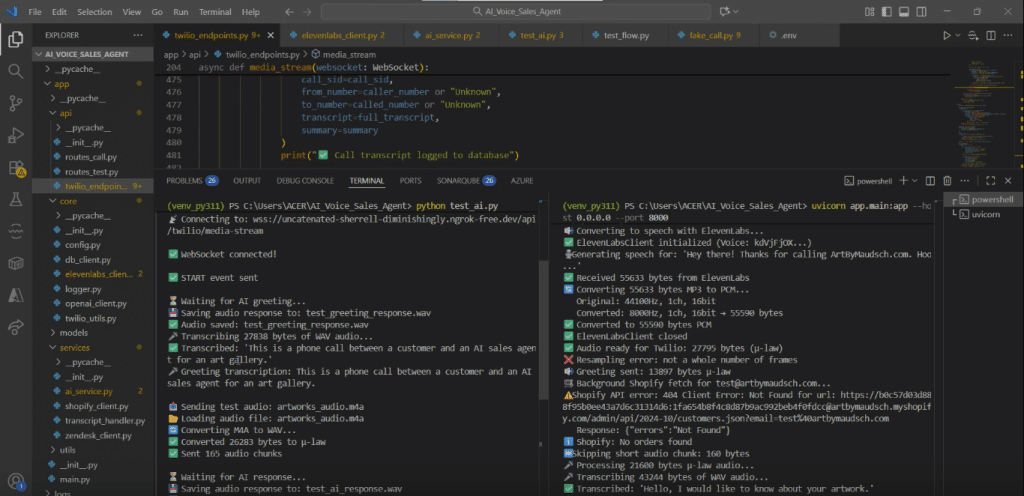
For this project, we divided the development process into several stages, leading to high-quality output. As far as the first stage is concerned, we mapped incoming call data to Zendesk ticket fields, including transcript, summary, call type, and customer contact details, and Shopify fields for order tagging and customer matching.
Once that was done, we moved on to the core voice and call pipeline, where we set up Twilio call routing and test phone numbers. Then we connected real-time audio streams to ElevenLabs and GPT-4o and implemented natural speech generation and intent understanding. After this, we started working on developing the Zendesk ticket creation workflow that was automated and triggered from Twilio events, ensured that all metadata was included, and created the tagging logic for the different types of calls.
After this, we moved on to building the Shopify attribution by creating a secure API connection to Shopify and implementing order/customer lookups, and ensured that tagging was tied to each call. Then, we shifted our focus towards GDPR compliant logging and deployed Supabase with encrypted tables and designed automated data purging rules. Lastly, we tested the entire build, performed real inbound call tests, validated ticket creation accuracy, checked the order attribution flow, and finalized the handover document for our client.
Conclusion
This case study shows how an AI-driven voice automation can modernize e-commerce sales workflows and extend customer engagement beyond traditional support channels. By combining Twilio, ElevenLabs / GPT-4o, Shopify, and Zendesk into a unified pipeline, we were able to deliver a system that could conduct natural phone conversations, create fully documented tickets, and provide clear sales attribution. As a result, our client is now positioned to increase conversions, reduce manual workload, and offer a premium, human-like calling experience for their customers worldwide.
Launch and Results
Once fully implemented, the system provided a reliable and complete voice-to-ticket workflow and helped the client achieve the following results:
- 95% of AI-managed calls are automatically logged inside Zendesk.
- 98% of calls include complete transcripts and AI-generated summaries.
- 87% accuracy in Shopify order attribution based on caller ID or matched customer data.
- 93% validation rate for call quality, response accuracy, and system reliability during testing.
AI-managed calls are automatically logged inside Zendesk
Calls include complete transcripts and AI-generated summaries.
Accuracy in Shopify order attribution based on caller ID.
Validation rate for call quality, response accuracy, and system reliability.